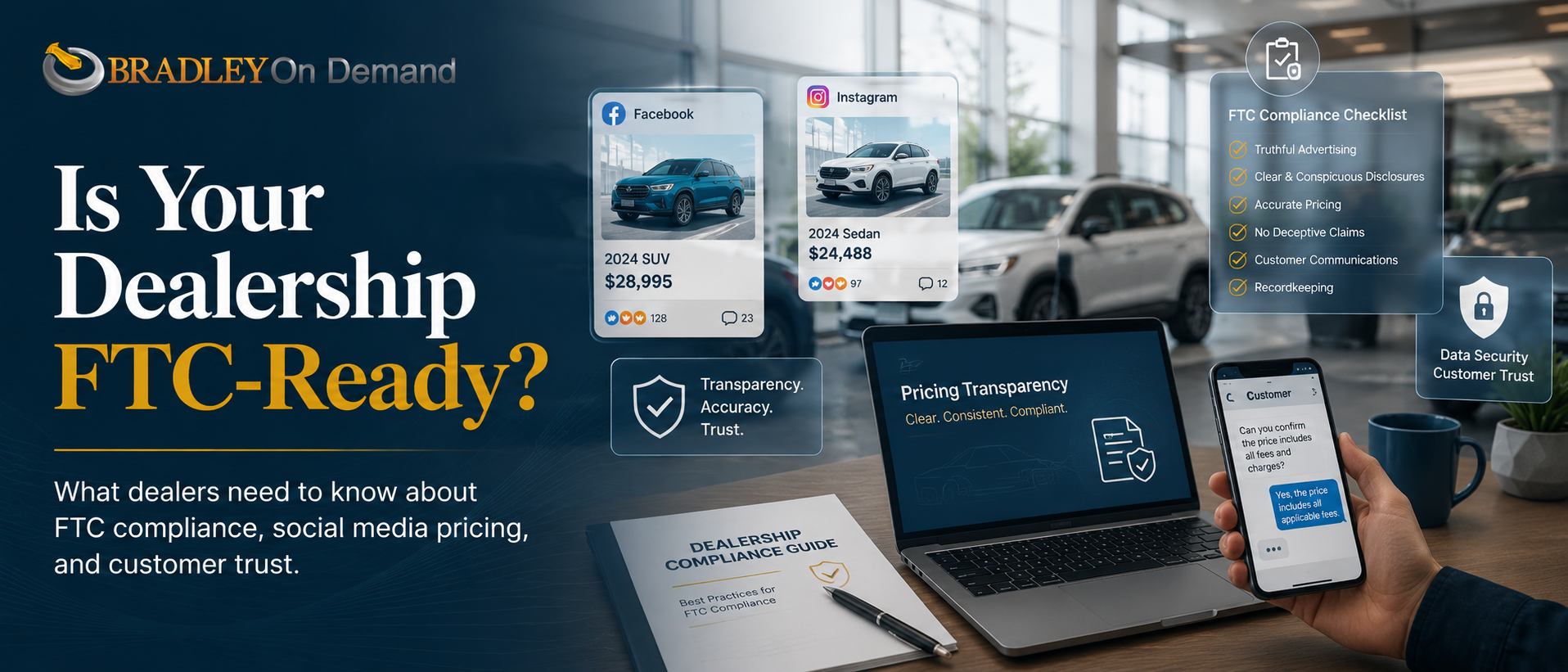

FTC compliance is no longer something dealerships can afford to treat as a back-office issue, a “manager-only” responsibility, or a once-a-year conversation. In today’s automotive retail environment, compliance touches nearly every part of the customer journey, from advertising and lead handling to pricing conversations, finance disclosures, documentation, data security, and follow-up.
The real question is not whether compliance matters.
The real question is: Is your dealership team trained, consistent, and ready?
Compliance Starts Before the Customer Walks In
Many compliance issues begin long before a customer sits in the showroom. They can start with an online ad, a payment quote, a social media post, a phone conversation, an email, or a text message.
Your dealership may have strong policies in place, but policies only work when your people understand them and apply them consistently. Salespeople, BDC agents, managers, finance managers, and leadership all need to be aligned on what can be said, what must be disclosed, and how information should be documented.
The FTC has made automotive retail a clear area of focus, including pricing, advertising, add-ons, financing, privacy, data security, and used vehicle disclosures. Dealers who sell or offer more than five used vehicles in a 12-month period generally must comply with the FTC Used Car Rule, which requires the Buyers Guide window sticker on used vehicles. The FTC also provides guidance for auto dealers under the Safeguards Rule, which focuses on protecting customer information.
Why FTC Readiness Matters
For dealerships, FTC readiness is about more than avoiding penalties. It is about protecting your business, your people, and your customers.
A compliant dealership culture helps:
- Reduce risk
- Improve customer trust
- Create consistent communication
- Strengthen documentation
- Protect customer information
- Build confidence across the team
- Support stronger management oversight
When your team is trained properly, they are less likely to guess, improvise, or accidentally create exposure for the dealership. Training helps turn compliance from a fear-based topic into a practical daily habit.
The Most Common Compliance Gaps Inside Dealerships
Many dealerships do not struggle because they lack intention. They struggle because different departments operate with different levels of understanding.
A salesperson may not know how to properly explain a disclosure. A BDC agent may quote information differently from the showroom team.
A manager may assume everyone understands the process, while newer employees may be learning through trial and error.
Some of the most common gaps include:
- Advertising and pricing consistency
Customers should receive clear, accurate, and consistent information. The FTC has warned dealerships about advertised prices needing to reflect the total price consumers are required to pay, including mandatory fees. - Disclosures and communication
Whether the conversation happens online, over the phone, by text, or in person, your team needs to understand how to communicate clearly and avoid misleading statements. - Add-ons and product presentation
Dealerships must be careful in how optional products, fees, and services are presented. Customers should understand what they are agreeing to. - Documentation and process control
If it is not documented properly, it becomes much harder to prove that the process was followed correctly. - Customer data security
Auto dealers that fall under the FTC Safeguards Rule are expected to maintain safeguards to protect customer information. This includes having a security program and ensuring customer data is handled appropriately.

FTC Readiness Is a Team Sport
Compliance cannot live in one office.
It cannot be the responsibility of only the GM, GSM, controller, compliance officer, or finance director. Every customer-facing employee plays a role. Every manager responsible for coaching and accountability plays a role. Every process that touches customer information plays a role.
That is why training matters.
Your dealership can have the best written policies in the world, but if your team does not know how to execute them in real conversations, those policies will not protect you the way they should.
FTC readiness requires three things:
- Knowledge: Your team needs to understand the rules, expectations, and dealership processes.
- Consistency: Customers should receive the same accurate information regardless of who they speak to.
- Accountability: Managers need to inspect the process and correct issues before they become bigger problems.
Is Your Dealership Actually FTC-Ready? (Checklist)
Ask yourself:
➡ Are your salespeople trained on compliant communication? (YES / NO)
➡ Are your managers reinforcing the same process every time? (YES / NO)
➡ Are your BDC and showroom teams aligned? (YES / NO)
➡ Are your advertising, pricing, and disclosure practices consistent? (YES / NO)
➡ Does your team understand how to handle customer information? (YES / NO)
➡ Are new hires trained before they begin working with customers? (YES / NO)
➡ Can your dealership show that training took place? (YES / NO)
If any of those answers are unclear, now is the time to tighten the process!
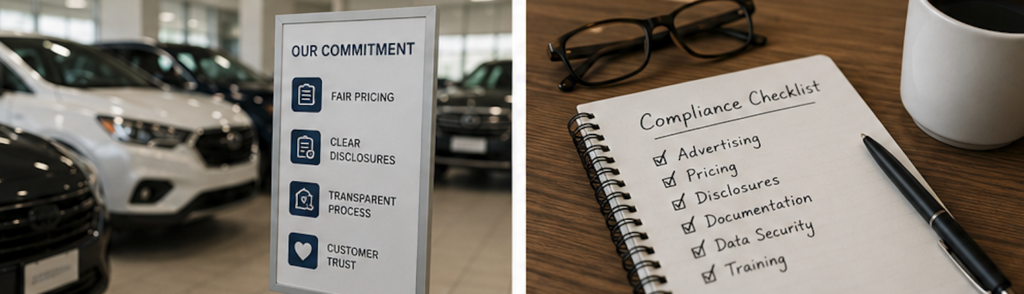
Compliance Today. Confidence Every Day.
The dealerships that win long term are the ones that train proactively, communicate clearly, and build processes their teams can actually follow.
So, is your dealership FTC-ready?
If not, now is the time to start.
Bradley On Demand Can Help Your Team Get FTC-Ready
Bradley On Demand offers FTC Compliance Training designed for automotive teams, including salespeople, managers, and dealership staff who need to understand how compliance shows up in daily operations.
The goal is simple: help your team stay informed, prepared, and confident.
With the right training, your dealership can reduce risk, improve consistency, build customer trust, and create a stronger compliance culture from the showroom floor to the management desk.
FTC compliance is not just about checking a box.
It is about protecting your dealership, empowering your people, and creating a better customer experience.
For more information about FTC Compliance Training for your dealership, reach out to: [email protected]

By: Tianna Mick, Chief Marketing Officer of Dealer Synergy
Tianna Mick, better known as T Got Your Keys, is a dynamic force in the automotive industry, renowned for her expertise in showroom sales, lead and referral generation, customer satisfaction, and personal and business branding, inspiring thousands to build their own automotive brands. At just 19, she became the top-grossing salesperson in her dealer group, averaging 20+ units monthly and earning over $10,000 per month. Her award-winning platform, TGotYourKeys.com, was named the #1 Personal Website in the Automotive Industry.
Today, Tianna is the official youngest NADA Workshop Speaker in history, a four-time NADA Convention speaker, five-time Digital Dealer speaker, three-time Internet Sales 20 Group speaker, and #1 Influential Female Car Salesperson, with over 6 million TikTok views. Her honors include the 2025 AutoSuccess Women at the Wheel, CDK Paving the Way Award (2024), and WOCAN Rising Star Award (2023).
She is the youngest Automotive CBT News Guest Feature, an Ally’s A-List Summit Academy graduate, and an international speaker at Canada’s Used Car Week and the Women Automotive Network Conference (UK), as well as ASOTU Con, DrivingSales, Women in Automotive, and FIADA. Featured in AutoSuccess, INC, Digital Dealer, and Bold Journey, she is also the youngest guest on Brad Lea’s Dropping Bombs Podcast. Invited by General Motors Corporate, Tianna speaks on diversity, inclusion, and LGBTQ+ economic impact. At 27, she is the Chief Marketing Officer at Dealer Synergy.